Why Hard Water Is a Problem in Irish Homes
If you’ve ever cleaned a kettle only to find a fresh layer of white scale a few weeks later, your water may be telling you something.
Across Ireland, hard water is common because natural minerals, particularly calcium and magnesium, enter the water as it moves through rock and soil. Uisce Éireann confirms that hard water is common in Ireland and that its hardness varies by location. Its online service allows households to check water hardness using an address or Eircode.
That means two homes only a few kilometres apart can experience different levels of hardness.
For homeowners, the issue usually isn’t whether hard water is safe. Uisce Éireann states that hard water isn’t harmful to health. The bigger concern is what happens when that mineral-rich water is repeatedly heated or allowed to evaporate.
That’s when limescale appears.
And if you’re regularly seeing scale inside your kettle, around your showerhead or on appliance heating elements, it’s worth paying attention.
What hard water actually means
Hard water contains naturally occurring minerals, mainly calcium and magnesium.
When water is heated, some of these minerals can form calcium deposits commonly known as limescale. Uisce Éireann specifically notes that heated hard water can create white calcium deposits inside kettles, kitchen appliances and heating systems.
You may notice:
- White deposits around taps
- Scale inside kettles
- Cloudy shower glass
- White marks on dishes
- Soap that doesn’t lather easily
- More frequent appliance cleaning
- Blocked showerheads
- Increased reliance on descaling products
One sign alone doesn’t necessarily mean an appliance is being damaged. But several signs appearing together can point towards a wider hard-water problem.
Why your Eircode matters
Water hardness isn’t uniform across Ireland.
That’s why a generic online answer can’t tell you exactly how hard the water is entering your home.
Your Eircode can provide a much more useful starting point. Uisce Éireann provides local hardness information based on the water supply zone, while Culligan also provides regional water-hardness information for Irish households.
If you’re buying a home, renovating a kitchen or simply wondering why your new dishwasher is already showing scale, checking your local hardness level is a sensible first step.
How Hard Water Damages Appliances
Hard water doesn’t usually destroy an appliance overnight.
Instead, the problem can build gradually.
A small amount of limescale becomes a larger deposit. A heating element becomes coated. Water flow becomes restricted. An appliance needs more cleaning or works less efficiently. Eventually, a component may need servicing or replacement.
That’s why hard water can be easy to overlook.
Calcium, magnesium and limescale
The chemistry is relatively straightforward.
Hard water carries calcium and magnesium. When the water is heated or evaporates from a surface, those minerals can be left behind as deposits.
This is why kettles are such an obvious warning sign.
The same principle applies inside other hot-water appliances and heating equipment. Uisce Éireann advises that limescale can form inside kettles, kitchen appliances and heating systems.
Over time, those deposits can affect performance.
Why heating makes the problem worse
Heating water accelerates the conditions that create visible scale.
Your kettle repeatedly heats the same water. Your dishwasher heats water during wash cycles. Your washing machine uses heated water for certain programmes. Heating systems also repeatedly transfer heat through components exposed to water.
So, if your home has hard water, appliances that heat water deserve particular attention.
Culligan Ireland explains that its water softeners use ion exchange to remove calcium and magnesium, helping prevent the limescale that forms from these hardness minerals.
The 5 Signs Your Appliances Are Being Ruined by Hard Water
The good news is that hard-water damage often leaves clues before an appliance completely fails.
Here are five of the most useful warning signs to watch for.
Sign 1: Limescale Keeps Appearing Inside Your Kettle
The kettle is often the household early-warning system.
If you’re descaling it every few weeks, especially if thick white deposits return quickly, your water is likely hard.
A little scale isn’t necessarily an emergency. But frequent build-up tells you that calcium and magnesium are repeatedly being deposited when the water is heated.
That can eventually affect the kettle’s heating performance.
You might notice:
- Longer boiling times
- A noisy kettle
- Flakes floating in water
- A visible coating on the heating element
- More frequent descaling
The same mineral build-up can occur elsewhere in your home.
What to do: Check your local water hardness and consider whether whole-home softening makes sense rather than repeatedly treating individual appliances.
Sign 2: Your Dishwasher Leaves White Marks
Open the dishwasher after a cycle and see cloudy glasses or white spots?
Hard water could be contributing.
Hard water can reduce the effectiveness of soaps and detergents, and mineral deposits can remain on dishes and internal surfaces. Uisce Éireann notes that hard water can reduce the effectiveness of detergents and soaps, meaning households may need to use more.
If you’re constantly adding more detergent, rinse aid or cleaning products just to get acceptable results, don’t automatically assume the dishwasher is faulty.
The water may be part of the problem.
Sign 3: Your Washing Machine Needs More Cleaning
Your washing machine may not show obvious limescale at first.
Instead, you may notice that laundry doesn’t feel as clean or fresh as you’d expect, detergent seems less effective, or the machine requires more frequent maintenance.
Hard water interacts with soap and detergents, which can make cleaning less efficient.
Over time, mineral deposits can also accumulate in water-heating components.
That doesn’t mean hard water is the sole cause of every washing-machine problem. Filters, detergent choice, temperature, loading and maintenance all matter.
But if several appliances in the same home are showing scale-related symptoms, your water quality deserves investigation.
Sign 4: Your Boiler or Heating System Is Losing Efficiency
This is potentially the most expensive warning sign.
Limescale isn’t limited to kettles and taps. It can form in heating systems where hard water is heated repeatedly.
A scale layer can interfere with heat transfer, meaning equipment may need to work harder to achieve the desired result.
Culligan Ireland highlights appliance and plumbing protection as a key benefit of domestic water softening and says reducing limescale can improve appliance efficiency.
This is where prevention can make financial sense.
Replacing a kettle is annoying.
Replacing major heating equipment is a different matter.
Sign 5: Showerheads and Taps Keep Blocking
If you’ve cleaned your showerhead recently and it already has white deposits, you’re seeing one of the most recognisable effects of hard water.
You may also notice:
- Reduced water flow
- White deposits around tap outlets
- Scale around shower fittings
- Persistent marks on chrome
- More frequent bathroom cleaning
The problem isn’t limited to appearance.
Mineral deposits can accumulate around water outlets and plumbing components.
Softening the water can reduce the amount of hardness mineral available to form new limescale.
What Hard Water Can Cost Your Household
The financial impact of hard water isn’t one single bill.
It’s the accumulation of smaller costs.
You might buy descaler. Replace a kettle sooner. Use additional detergent. Call a plumber. Clean appliances more often. Eventually, a component may need replacement.
That’s why it’s useful to think about total household cost, rather than simply asking how much a water softener costs.
Repair and replacement costs
Consider a simple example.
If hard water contributes to premature wear on several appliances, the replacement cost can quickly become significant.
A household might eventually face:
| Potential issue | Possible household impact |
| Kettle scale | More frequent replacement or descaling |
| Dishwasher scale | Reduced cleaning performance and servicing |
| Washing machine deposits | Maintenance and component wear |
| Showerhead blockage | Reduced flow and replacement |
| Heating-system scale | Potential efficiency and maintenance issues |
| Plumbing deposits | Restricted flow and professional attention |
These aren’t guaranteed costs, and hard water isn’t responsible for every appliance failure.
However, persistent scale is a sensible reason to investigate the underlying water hardness.
Energy and detergent costs
There’s another side to the equation.
Hard water can make soaps and detergents less effective. Uisce Éireann specifically recommends recognising this effect when dealing with hard water.
Culligan also identifies reduced detergent use and improved appliance efficiency among the potential benefits of water softening.
So the financial question isn’t simply:
“How much does a softener cost?”
It should be:
“How much am I already spending managing hard water?”
That change in perspective can make the decision much clearer.
How a Water Softener Protects Appliances
A water softener tackles the problem at its source rather than asking you to repeatedly clean the symptoms.
How ion exchange works
Culligan domestic water softeners use ion-exchange technology.
Hard water passes through resin beads inside the softener. The resin attracts calcium and magnesium ions and exchanges them for sodium ions. Once the resin becomes saturated, the system regenerates using a salt solution so it can continue operating.
In simple terms:
Hard water → calcium and magnesium captured → softened water → less hardness-related scale
This is fundamentally different from simply filtering water through a standard drinking-water filter.
Why softening is different from filtration
A water softener is designed primarily to reduce water hardness.
A drinking-water filter or reverse osmosis system has a different purpose.
Culligan’s filtration range includes systems designed to address impurities, odours, tastes and other water-quality concerns, while its softeners specifically address hardness minerals.
That’s why some homes benefit from both.
Benefits of Installing a Water Softener
A water softener isn’t simply about making your taps look cleaner.
It’s about reducing the ongoing effects of hard water throughout the home.
Appliance protection
Reducing calcium and magnesium can help reduce the formation of limescale in treated water systems.
Culligan identifies appliance lifespan and reduced limescale build-up as key benefits of its home softeners.
Easier cleaning
With less scale being deposited, you may spend less time scrubbing:
- Shower screens
- Taps
- Sinks
- Tiles
- Kitchen fixtures
- Appliance interiors
It’s not glamorous, but anyone who has spent Saturday morning scrubbing limescale knows that small improvements add up.
Lower detergent use
Soft water can improve soap and detergent performance.
That can potentially reduce how much product you need for cleaning, laundry and personal care.
Softer-feeling water
Many households also notice a difference in how water feels on skin and hair.
Culligan highlights softer-feeling skin and hair as one of the lifestyle benefits associated with softened water.
What Does a Water Softener Cost in Ireland?
The price depends on the model, household requirements, installation and features.
For example, Culligan’s current online listings include the Culligan Arc and Minimax M3, while the Arc is listed at €1,350 on Culligan’s online shop at the time of writing.
That doesn’t mean every Irish home needs a €1,350 system.
The right choice depends on:
- Your water hardness
- Household size
- Daily water consumption
- Available installation space
- Required flow rate
- Salt requirements
- Installation complexity
- After-sales support
- Maintenance requirements
Product and installation considerations
A low headline price isn’t necessarily the lowest long-term cost.
Check what’s included.
Does the quote include installation? Is professional support available? What happens if the unit needs servicing? Are compatible salt products easy to obtain?
Culligan provides installation and maintenance services for domestic water softeners, including professional installation and ongoing support.
Ongoing salt and maintenance
Salt-based softeners need salt for regeneration.
The amount varies according to water hardness, household usage and the softener itself.
Culligan supplies both crystal and block salt for compatible systems.
The key is to choose a system that matches your home rather than buying the largest unit available.
Which Culligan Solution Could Suit Your Home?
There isn’t one universal solution for every Irish household.
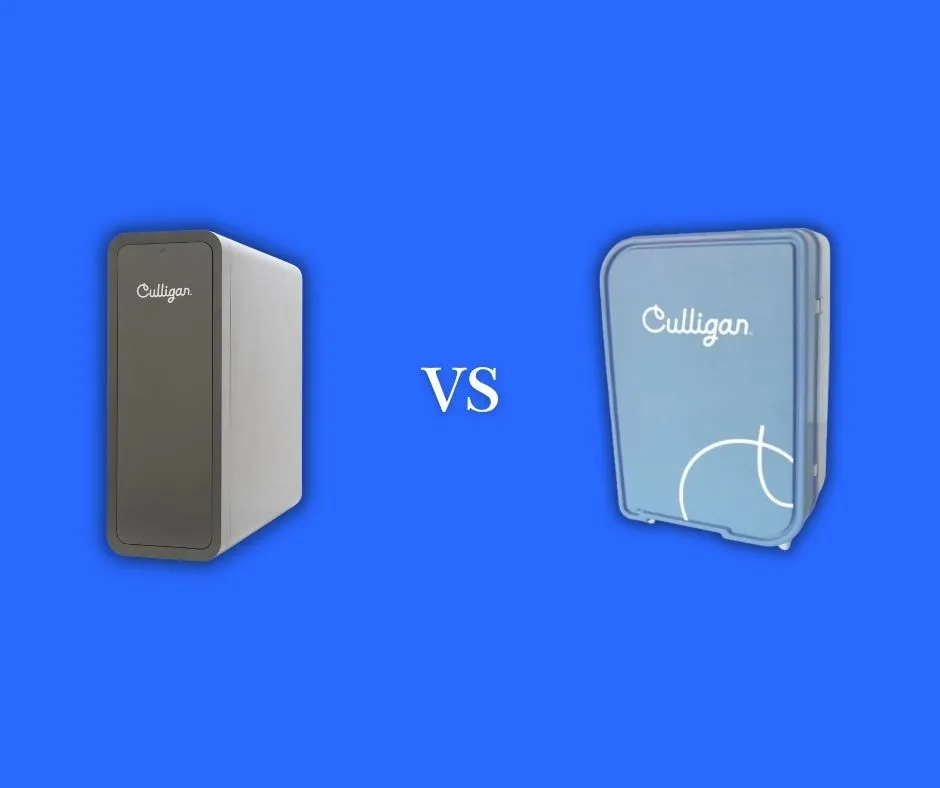
Culligan Arc
The Culligan Arc is a compact twin-tank water softener designed for domestic use.
It uses non-electric operation, has smart salt-level monitoring and is designed to fit under a kitchen sink. Its twin-tank configuration provides a continuous supply of softened water.
Explore the Culligan Arc Water Softener
Minimax M3
The Minimax M3 uses twin-cylinder technology and operates without electricity using water pressure.
Culligan’s current product information lists a compact design, block-salt operation and automatic metering.
It’s worth comparing the two based on your water hardness, household usage, available space and preferred features rather than simply choosing the model with the longest specification sheet.
Reverse osmosis for drinking water
A softener and a reverse osmosis system can complement each other.
The softener deals with household hard water and limescale.
An RO system focuses on drinking and cooking water.
Culligan’s Compact Reverse Osmosis system uses a five-stage filtration process and includes a remineraliser, while the wider Culligan RO range includes compact under-sink systems.
Explore Culligan Reverse Osmosis & Filtration Systems
Two Irish Household Stories
The following are illustrative household scenarios based on common hard-water problems described in Culligan’s Irish content, rather than independently verified customer testimonials. They’re included to show how the symptoms can appear in everyday homes.
A Dublin household dealing with kettle scale
Imagine a family in Dublin that is repeatedly descaling its kettle.
At first, it seems like a minor inconvenience.
Then the same white deposits start appearing around the taps and showerhead. Glasses come out of the dishwasher with marks, and cleaning the bathroom becomes a regular battle.
The family checks its local water hardness and discovers that the supply is in a very hard-water area.
Instead of treating every appliance separately, they investigate whole-home softening.
The lesson isn’t that every Dublin home automatically needs a softener. It’s that multiple symptoms appearing together are worth investigating.
A Galway household dealing with appliance maintenance
Now consider a household in Galway where a family is constantly dealing with showerhead scale and kettle deposits.
They’ve already tried descaling products and replaced small components.
The individual costs aren’t enormous, but they’re recurring.
After checking the water hardness, they decide to compare the cost of ongoing maintenance with the cost of installing a water softener.
Again, the important point is not that a softener guarantees a particular saving.
It’s that the household has moved from repeatedly treating symptoms to addressing the underlying hardness problem.
How to Check Your Water Hardness
You don’t need to start by buying equipment.
Check your Eircode
Uisce Éireann provides a hard-water information service that allows households to check their water hardness by entering an address or Eircode.
This is one of the easiest ways to understand whether your home is likely to experience significant hardness.
Look for everyday warning signs
Then look around your home.
Ask yourself:
- Does my kettle develop scale quickly?
- Are my taps covered in white deposits?
- Do my shower fittings block regularly?
- Are my glasses cloudy after washing?
- Do I use large amounts of detergent?
- Does my heating system require frequent attention?
- Am I constantly buying descaling products?
If you answered yes to several, it’s worth investigating further.
When Should You Consider a Water Softener?
A softener may be worth considering if hard water is creating a recurring household problem rather than an occasional annoyance.
Particularly consider it when:
- Your local water supply is hard or very hard.
- Limescale returns quickly after cleaning.
- Multiple appliances show scale.
- Your household uses a lot of hot water.
- You spend regularly on descaling products.
- You want to protect appliances and plumbing.
- You’d prefer to prevent scale rather than repeatedly remove it.
The decision should be based on your home’s actual water conditions.
Culligan recommends a water analysis and consultation to help determine the appropriate system for a particular property.
Get advice on Culligan water softeners for your home
How to Choose the Right System
The best water softener isn’t necessarily the biggest or most expensive.
Look for a system that is correctly matched to your home.
| Consideration | Why it matters |
| Water hardness | Determines how much softening capacity you need |
| Household size | More people usually means greater water demand |
| Water consumption | Influences regeneration requirements |
| Installation space | Important for compact Irish kitchens |
| Twin-tank design | Can provide continuous softened water |
| Salt format | Must match the system |
| Maintenance | Affects long-term convenience |
| Warranty/support | Important over the life of the appliance |
| Installation | Professional installation helps ensure correct setup |
Don’t forget the drinking-water question either.
If you want improved taste or additional filtration for drinking and cooking, a separate filtration or RO system may be appropriate.
Frequently Asked Questions
Is hard water harmful to drink?
No. Uisce Éireann states that hard water isn’t harmful to health and is common in Ireland. However, it also notes that chemically softened water may not be suitable for everyone, including certain infants and at-risk groups.
Always consider your household’s specific drinking-water requirements before deciding how your water should be treated.
Does hard water really damage appliances?
Hard water can contribute to limescale formation inside appliances and heating systems, particularly where water is heated repeatedly. Uisce Éireann specifically identifies limescale deposits in kettles, kitchen appliances and heating systems.
That doesn’t mean hard water causes every appliance failure, but persistent scale is a legitimate reason to investigate water hardness.
What appliances are most affected by hard water?
Kettles, dishwashers, washing machines, boilers, hot-water systems and shower fittings can all be affected by limescale.
Heating appliances can be particularly relevant because hard water forms scale when heated.
Will a water softener remove existing limescale?
A softener primarily prevents new hardness minerals from forming limescale in treated water. It shouldn’t be viewed as an instant chemical cleaner for every existing deposit.
Existing scale should still be cleaned according to the appliance manufacturer’s instructions.
Does a normal water filter soften water?
Usually, no.
Standard drinking-water filters and water softeners perform different jobs. Culligan’s filtration systems are designed for drinking-water treatment, while its softeners use ion exchange to reduce calcium and magnesium hardness.
How much does a water softener cost in Ireland?
There isn’t one universal price.
Current Culligan listings show domestic models at different price points depending on the system and configuration. For example, the Culligan Arc is currently listed online at €1,350, while other models have different pricing.
Installation and ongoing requirements should also be considered when comparing quotes.
How often does a water softener need salt?
It depends on water hardness, household water consumption and the softener’s capacity and regeneration settings.
Rather than relying on a generic refill schedule, monitor the system and follow the manufacturer’s instructions.
Can I have a water softener and reverse osmosis system?
Yes.
They address different objectives.
A softener reduces hardness minerals throughout the treated household supply, while RO is designed for drinking and cooking water treatment. Culligan explicitly states that under-sink filtration and water softening can be used together.
Is a water softener worth it for a Dublin home?
It depends on your property’s water hardness and household needs.
Culligan’s Dublin hardness information currently identifies Dublin as a very hard-water area, while Uisce Éireann recommends checking your specific supply zone using your address or Eircode.
Does soft water help reduce cleaning?
It can.
Because soft water contains fewer hardness minerals, there is less mineral scale available to deposit on taps, shower screens and other surfaces. Culligan identifies easier cleaning as one of the benefits of domestic water softening.
Protect Your Appliances Before the Damage Adds Up
Hard water is easy to ignore because the damage is usually gradual.
A kettle still boils. A dishwasher still runs. A shower still works.
But repeated limescale deposits can mean more cleaning, more descaling, less efficient operation and potentially more maintenance over time.
The first step is simple: check your local water hardness using your County
If your home has hard or very hard water and you’re seeing several of the warning signs above, it may be time to consider whether a whole-home water softener makes financial and practical sense.
Culligan Ireland offers water softeners, drinking-water filtration, reverse osmosis and professional installation and maintenance, allowing you to build a water-treatment solution around the needs of your home.
Explore Culligan Water Softeners for Irish Homes